Kokoseb Gold Project, Namibia
Tenure
The Kokoseb Gold Project is located in north-west Namibia approximately 320km by road from the capital city of Windhoek. Kokoseb lies within the Okombahe Exploration Licence, which is held under joint venture by WIA (80%) and the Namibian state-owed mining company, Epangelo.
The Okombahe EL is part of WIA’s broader Damaran Belt tenure in Namibia, which consists of 12 tenements across a total area of over 2,700km2.
Domicile
Namibia is a leading African mining jurisdiction, being politically and socially stable, and possessing well-developed infrastructure including roads, rails and ports. It has a long and established history as a major producer of uranium, diamonds, and base metals, as well as hosting several high-quality gold mines including Otjikoto (B2Gold) and Navachab (QKR). Namibia also consistently ranks as one of the premier African investment jurisdictions in the annual Fraser Institute Mining survey.
Geology
The Kokoseb gold deposit lies within the Northern Central Zone of the Pan-African Damaran Orogenic Belt. The Project area is underlain by neo-Proterozoic metasediments of the Arandis, Karibib and Kuiseb Formations of the Swakop Group. Gold mineralisation is found in the Kuiseb Formation metasediments which are extensively intruded by both late syn-tectonic and post tectonic granites, and minor N-S to NNE-SSW trending mafic dykes. There is generally moderately to good exposure throughout the licence area though, the Kuiseb formation tends to only sub-outcrop and is commonly covered by thin soil, colluvium or pisolitic calcrete up to 2m thick.
Within the Kokoseb area, the Kuiseb schist forms a domal feature cored by a post tectonic leucogranite, the “Central Granite Pluton”, which consists predominantly of medium grained quartz, K-feldspar and plagioclase, with accessory biotite, muscovite, magnetite, garnet and tourmaline. Granite dykes, granitic veinlets and pegmatites cross cutting the Kuiseb schist represent the same granite phase or later granitic phases. Gold mineralisation wraps around this pluton in a roughly arcuate form of 3km diameter. A coarse grained, pre-syn tectonic, porphyritic-feldspar granite encloses the mineralised schists in the west, east and northeast. The schist units consist of poorly foliated, dark grey, quartz/plagioclase/K-feldspar rich, biotite bearing, schist and black, better foliated biotite schists.
Gold mineralisation, present as native gold grains and lesser silver bearing gold grains, is spatially associated with sulphides dominated by pyrrhotite, löllingite and arsenopyrite in order of abundance.

Formation metasediments which are extensively intruded by both late syn-tectonic and post tectonic granites, and minor N-S to NNE-SSW trending mafic dykes. There is generally moderately to good exposure throughout the licence area though, the Kuiseb formation tends to only sub-outcrop and is commonly covered by thin soil, colluvium or pisolitic calcrete up to 2m thick.
Within the Kokoseb area, the Kuiseb schist forms a domal feature cored by a post tectonic leucogranite, the “Central Granite Pluton”, which consists predominantly of medium grained quartz, K-feldspar and plagioclase, with accessory biotite, muscovite, magnetite, garnet and tourmaline. Granite dykes, granitic veinlets and pegmatites cross cutting the Kuiseb schist represent the same granite phase or later granitic phases. Gold mineralisation wraps around this pluton in a roughly arcuate form of 3km diameter. A coarse grained, pre-syn tectonic, porphyritic-feldspar granite encloses the mineralised schists in the west, east and northeast. The schist units consist of poorly foliated, dark grey, quartz/plagioclase/K-feldspar rich, biotite bearing, schist and black, better foliated biotite schists.
Gold mineralisation, present as native gold grains and lesser silver bearing gold grains, is spatially associated with sulphides dominated by pyrrhotite, löllingite and arsenopyrite in order of abundance.
Discovery
Preliminary soil sampling and trenching programs identified a large, coherent +100ppb gold anomaly at Kokoseb in late 2021.
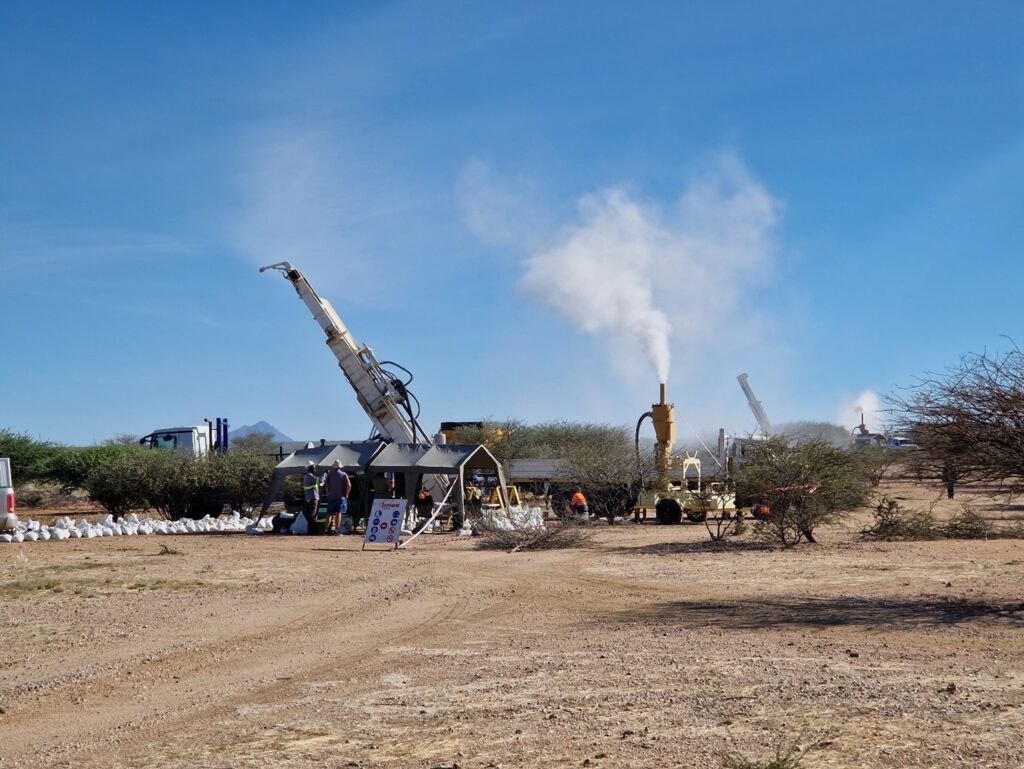
Initial testing of this anomaly was undertaken via a small-scale reconnaissance diamond drilling program during Q2 2022, consisting of 12 holes for 1,747 metres drilled. The return of multiple thick, shallow, high-grade intercepts from this program demonstrated the potential for a major gold deposit to exist at Kokoseb.
Successive reverse circulation and diamond drilling programs have progressively expanded the known extents of the Kokoseb deposit over the past two years.

Current Mineral Resource Estimate
| Cut off (Au g/t) | Tonnes (Mt) | Au (g/t) | Au (Moz) |
|---|---|---|---|
| 0.20 | 130 | 0.69 | 2.88 |
| 0.25 | 115 | 0.75 | 2.77 |
| 0.30 | 100 | 0.80 | 2.57 |
| 0.40 | 83 | 0.91 | 2.43 |
| 0.50 | 66 | 1.0 | 2.12 |
| 0.60 | 53 | 1.2 | 2.04 |
| 0.80 | 34 | 1.4 | 1.53 |
| 1.00 | 23 | 1.7 | 1.26 |
During May 2023, WIA declared a maiden Inferred Mineral Resource Estimate (MRE) for Kokoseb of 1.3 Moz at 1.0 g/t Au (0.5 g/t Au cut-off grade). This initial MRE included a higher-grade component of 0.72 Moz at 1.5 g/t Au (1.0 g/t Au cut-off grade).
The initial MRE was delivered within only 12 months of drilling the initial discovery holes at Kokoseb.
In April 2024, WIA released an updated Inferred MRE for Kokoseb of 2.1 Moz at 1.0 g/t Au (0.5 g/t Au cut-off grade). This represented a 63% increase in contained gold from the maiden MRE. The updated MRE also included a higher-grade component of 1.53 Moz at 1.4 g/t Au (0.80 g/t Au cut-off).
The Kokoseb deposit boasts one of the lowest discovery costs globally, standing at less than US$3/oz of MRE contained gold.
Positive Initial Metallurgy
Preliminary metallurgical test results have returned excellent gold recoveries above 91% via gravity and standard direct leach process, confirming the clear development potential of Kokoseb.
Latent Further Growth Potential
The Kokoseb mineralisation remains open in every direction and at depth.
The optimised MRE pit shell extends along 4.8km strike, from a total 6.5km strike covered by the geological model. Multiple further target areas exist with significant growth potential:
- Depth extensions of the plunging shoot. The high-grade Central plunging shoot, centred on KRC086 (which returned 37m at 9.46 g/t Au), is currently interpreted as steeply plunging towards the south, connecting up dip with recent drill results from KRC176 (which returned 12m at 5.15 g/t Au and 10m at 5.51 g/t Au).
- New sub parallel zones. Some drill results (deeper intercept in KRC006 for example) could not be incorporated in the MRE model, suggesting they belong to additional mineralised zones or domains which need to be drill tested specifically.
- Extensional drilling along strike. The Eastern Zone has not been drilled sufficiently to be included in the current MRE. However gold mineralisation was intersected in every drill hole completed in this area.
- Potential for hidden gold mineralisation under the regional southern thrust. Drill testing is underway along the thrust.
Drilling is ongoing with a dual focus on further substantial MRE growth as well as classification upgrade.